Friday, December 29, 2006


The NT Words in Question

There are two NT Greek words which are translated repentance in modern English translations: metanoia (and its verbal counterpart metanoeo„„) and metamelomai. The former term is so translated fifty-eight times in the NT; the latter only six times. The much wider use of metanoia has led me to give it greater attention in this article.

The Pre-Christian Meaning of Metanoia

In Classical Greek metanoia meant changing one's mind about someone or something. For example, Thucydides used the term when writing about the response of the Athenian council to a revolt. The council decided that all of the men of the city of Mytilene were to be put to death--not merely those who participated in the revolt. However, on "the next day a change of heart came over them."62 The Athenian council changed its mind. It decided that only those who participated in the rebellion should be put to death.

Another example is found in Xenophon's use of our term. He wrote:

We were inclined to conclude that for man, as he is constituted, it is easier to rule over any and all other creatures than to rule over men. But when we reflected that there was one Cyrus, the Persian, who reduced to obedience a vast number of men and cities and nations, we were then compelled to change our opinions and decide that to rule men might be a task neither impossible nor even difficult, if one should only go about it in an intelligent manner.63

During the pre- and early Christian period of KoineÁ Greek (ca. 300 BC-100 AD) metanoia continued to carry the sense of a change of mind about someone or something. For example, Polybius (ca. 208-126 B.C.) used metanoia to refer to the Dardani, a people who had decided to attack Macedonia while Philip was away with his army. However, Philip caught wind of it and returned quickly. Even though the Dardani were close to Macedonia, when they heard that Philip was coming, they changed their minds. They broke off the attack before it even began.64

Similarly, Plutarch, who lived and wrote in the late first and early second century A.D., wrote:

Cypselus, the father of Periander . . . when he was a new-born babe, smiled at the men who had been sent to make away with him, and they turned away. And when again they changed their minds, they sought for him and found him not, for he had been put away in a chest by his mother.65

Notice that in all of the cases cited the individual or people in view had thought one thing or made one decision and then, based on further evidence or input, changed their minds.

Thompson suggests that two other nuances emerge during this period: change of purpose and regret.66 However, the evidence does nor substantiate her claim. On both counts she is guilty of "illegitimate totality transfer," that is, the unwarranted transfer of the meaning of a phrase containing a given word to that word when it stands alone. She fails to show any examples where either metanoia or its verbal counterpart was used absolutely in the senses which she suggests. Rather, it is other words in the context which indicate that the change of mind in question concerned sinful practices or was accompanied by grief or sorrow.

Metanoia and metanoeo„„ occur twenty times in the canonical books of the Greek OT (Septuagint) and seven times in the apocryphal books. They retain the meaning of a change of mind about someone or something in the LXX.67 The following examples are representative.

When the Lord decided to take the kingdom from King Saul He instructed Samuel to say, "He will not turn nor change His mind, for He is not as a man that He should change His mind" (I Sam [1 Kingdoms in the Septuagint] 15:29; translation mine).

Likewise, Prov 20:25 speaks of how foolish it is for a man to rashly promise to give something to the Lord, because after such a hasty vow the man may come to change his mind.

Similarly, the Ninevites believed in the Lord and turned from their sinful ways in the hopes that the Lord might change His mind and not destroy t hem and their city (Jonah 3:9-10). From a human perspective God did indeed change His mind and withhold the judgment He had planned.68

Behm disagrees. He argues that metanoeo„„ in the Greek OT "approximates" shu‚b of the Hebrew OT.69 However, I believe he fails to prove his point. The term shu‚b was used 1,056 times in the Hebrew text. None of those occurrences is translated by metanoeo„„ in the Greek OT. Not one. This is inexplicable if the translators of the LXX felt that metanoeo„„ was a good translation of shu‚b. Rather, the translators routinely used strepho„ and its various compound forms to translate shu‚b.

In the OT pseudepigrapha metanoia and metanoeo„„ nearly always occur in contexts dealing with the need to abandon sinful practices in order to escape God's judgment. Behm concludes from this that metanoia had thus come to refer to turning from sins. He too, however, is guilty of illegitimate totality transfer. Metanoia did not come, by itself, to refer to a turning from one's sins. Rather, words in the context inform the reader that the change of mind in view would include a resolution to cease the sinful practices mentioned.

In summary, the pre-Christian meaning of metanoia was a change of mind about someone or something. When the context specifically mentions sinful practices about which one was changing his or her mind, the translation "repentance" is acceptable.


**********

II. Meaning of Metanoia in the NT

Basic Sense: Change of Mind

The pre-Christian meaning of metanoia as a change of mind is its basic NT sense as well. This can readily be seen in Heb 12:17 which reads: "For you know that afterward, when he wanted to inherit a blessing, he [Esau] was rejected, for he found no place for metanoia, though he sought it diligently with tears." What was it that Esau could not find? It was not a turning from sinful behavior. It was not penance. What he could not find was a way to change his father's mind. The matter was settled. No matter how much he pleaded, he couldn't change Isaac's mind.

All NT uses include the sense of a change of mind present. However, if the context clearly indicates what one is changing his mind about, it could be that a more polished English translation can be found. For instance, if one is to change his mind about his sinful deeds, the term repentance conveys that thought nicely.


Sunday, December 03, 2006


I Know A Metaphor When I See One
by Joan Chittister

Dec 1, 2006

Road to Damascus Still A Place For Conversions


The movie "Everest," now showing at the local IMAX theater, sent chills down my spine. There, in the middle of the Himalayas, a group of climbers found themselves blocked on their way to the summit by a fracture in the snow 90 feet deep. The crevasse was too wide to jump, but at the same time too narrow to simply accept as the end of their 30,000-foot attempt to conquer the highest mountain in the world. So they opened up a telescoped pole ladder, laid it across the icy ravine and in large, clunky, steel-clawed boots walked across the open spaces between its rungs, toes on one rundle, heels on the other.

I know a metaphor when I see one. I felt like I had just been part of a similar climb myself, sure of the need to go on, not sure that the passage was safe.

In Lebanon the week before, spiritual leaders from every side of the religious crevasse -- Hindu, Buddhist, Muslim, and Orthodox -- met in the first-ever Middle East-Asian Spiritual Dialogue to discuss the role of religion and the road to peace. They were sheikhs and monks and archbishops and patriarchs and judges and theologians.

They were leaders of religious groups who had long been at odds with one another. And they were now trying to take the first steps across the historical fissures that were keeping them from uniting a globe where borders were fast disappearing, where cultures were all becoming polyglot, where no one was safe from having to deal with the others any more.

No doubt about it: This was not one more routine academic convention.

This meeting was happening in a city where the marks of bombs were frighteningly fresh. Bridges were still out in the center of the city. Makeshift steel beams creak and groan under the traffic they carry from one side of the overpass to the other. One whole section of the city lies in rubble. The apartment buildings that remain standing are hung with canvass. Why? Because families with nowhere else to go have crept back into the condemned buildings and live their still. The sheets of canvas cover the gaping holes left by the missiles and keep out the cold and rain from the children who peek around the corners of the scars.

This was a meeting where the participants, religious figures all, spoke across the great divides of time and tradition, of place and peoples, to heal the wounds of division and prejudice that threaten the very globe again. They shared their spiritual traditions with one another. They got to know one another. They defined their moral values. They talked about the sacredness of life and the need for compassion. They talked about how they saw God, how they prayed, what they knew to be the purpose of life.

Where I grew up, something like that was impossible. Catholics hardly spoke to Protestants; Protestants barred Catholics from public life, never mind Hindus or Buddhists, Muslims or Orthodox.

But the problem is that even now, even here in the United States, we still do far too little to bridge our own divides while those very differences are being exploited everywhere. Here imams cannot board a plane without being eyed with suspicion, and children cannot carry stuffed toys on board without being screened and searched and half undressed at checkpoints. Muslims are changing their names in order to get jobs and we, too, are building barbed-wired walls on our border.

Instead of launching great spiritual conferences and study groups and social projects together so that we can come to understand and respect one another's spiritual beauty, we are strengthening the walls of our own spiritual ghettoes.

For our part, we are worrying about stamping out feminine images of a God already called rock, tree, light, fire and dove. But this God, the very womb of the universe, must never ever be called "mother" in the hymns of the church.

We are worrying about keeping the gay community invisible, warning them not to talk about their sexual identity in their parishes, reaching out to them in one sentence, explaining their theological disorders to them in another.

We are tidying up our rituals and reclaiming our "identity" while "identity" -- if we mean the old WASP paradigm or White, Anglo-Saxon, Protestant USA -- gets more mulatto, more Eastern, more "other" every day.

This conference, under the auspices of His Holiness Aram I, Catholicos of Cilicia of the Armenian Apostolic Church and the Most Venerable Master Sheng Yen, founder of Dharma Drum Mountain in Taiwan, called for a great deal more. As Master Sheng Yen put it, we must "focus on the shared needs of humankind as a whole. … We must find a common path that reflects a set of global ethics which transcends religion, ethnicity and culture."

Let's put it this way: Bombs and bullets are not doing it. The world is more dangerous now than when we invaded Iraq. Iraq itself is worse off now than it was when we first went there. The Middle East is less stable now than it was before we sent all our weapons in to stabilize it. And we ourselves are poorer for it: Poorer in international relations. Poorer in social development here. Poorer in moral stature around the world.

From where I stand, it seems to me that it's time for all of us to put a pole ladder over the fissures we have created between us and the rest of the world and start walking. Awkward as we are. Dangerous as it is. Unsure as we may be. There is no other way to get to the other side now because there is no "other side."

We are all in this one together and we are surely too close to the summit now to quit.


Advent speaks to the power of smallness - Column

Joan Chittister

It's Advent again. And if anyone cares about Advent, Americans should.

Advent may have more to do with American life than any other season of the year. Yet, Advent remains the period of spiritual preparation that is too often least appreciated, little understood and commonly ignored.

One of the problems with Advent is that it gets swallowed up by Christmas. The truth is, of course, that Advent signals the coming of Christmas. But the kind of Christmas the liturgical period of Advent is meant to signal is not the Christmas we celebrate in the United States. Civil Christmas is about the storing up of things. The Christmas to which Advent points is about being emptied out so we can become full.

Advent is about the spirituality of emptiness, of enough-ness, of stripped-down fullness of soul. Advent points to the essentials of life; commercial Christmas points to its superfluities.

The two great liturgical seasons of the church year, Advent and Lent, are about very different things. Advent is not "a little Lent." Advent is not a penitential period. Advent comes to trigger consciousness, not to provoke our consciences.

The Talmud teaches that every person should wear a jacket with two pockets. In the one pocket, the rabbis say, there should be a note that reads, "I am a worm and not completely human." And in the second pocket, the rabbis say, the note must read, "For me the universe was made."

The story is clear: The function of Lent is to remind us who we are--and who we are not. The function of Advent, on the other hand, is to remind us who God is and who we are meant to be, as well. Advent is about the riches of emptiness.

The Jesus "who did not cling to being God," but is like us in all things, models what most of us take the greater part of our lives to learn: how to "be ourselves." The divinity who comes to us as an infant is the paradigm of what it means to learn from life as we grow into who and what we're meant to be. The God who comes without retinue or riches is the metaphor of a humility that requires us to remember how really small we are in the universe--and to come to the point where that is enough for us.

Advent is about the power of emptiness and the spiritual meaning of smallness.

When we have little to begin with, we have even less to lose. We know, then, that we don't have all the ideas or all of the answers. It means that we have nothing to fight over and even less to boast about in life. We become full of possibility.

When we know who we really are, when we present no disguises and parade no pretensions, when we are honest both with ourselves and with others, we fired ourselves free to be ourselves. We have no image to keep up, no lies to gild in a gilded society. We become full of integrity.

When we learn to live with the basics rather than to hoard what does not belong to us, we can never be made bereft by the loss of life's little baubles because we never depended on them in the first place. We become full of contentment.

When we recognize our own limitations, we need never fear failure. Then we can't possibly be destroyed by losing because we never anointed ourselves entitled to win. We become full of confidence.

Finally, when Advent seeps into our souls, we come to understand that small is not nothing and empty is not bereft. To be small is to need, to depend on the other. Smallness bonds us to the rest of the human race and frees us from the arrogant isolation that kills both the body and the soul. To be empty is to be available inside to attend to something other than the self. We become full of the blessings of life.

Then, emptied out by the awareness of our own smallness, we may have the heart to identify with those whose emptiness, whose poverty of spirit and paucity of life is involuntary. Then, we may be able to become full human beings ourselves, full of compassion and full of consciousness.

An Advent spent in serious reflection on the power of emptiness and the meaning of smallness puts everything else in perspective. Most of all, ourselves. Or, as Isaiah put it, "The eyes of the arrogant man will be humbled and the pride of men brought low."

Benedictine Sr. Joan Chittister, author and lecturer, lives in Erie, Pa.

COPYRIGHT 2003 National Catholic Reporter


Ethics as Love

It is not often enough noted that this capacity to love intentionally, with the whole of one's being, is what makes a human being
godlike. If man is made in the image of God -- and this is the view of both the Judaic and the Christian teaching -- it means he is built to be capable of love. "God is love."

Judaism

Here one sees the answer to the riddle of the serpent in paradise -- a story that has so much to teach us about the meaning of love between a man and woman. The serpent tempts Eve in the painfully mysterious moment when Eve says to the serpent:

But of the fruit of the tree which is in the midst of the garden, God hath said, Ye shall not eat of it, neither shall ye touch it, lest ye die.
And the serpent said unto the woman, Ye shall not surely die:
For God doth know that in the day ye eat thereof, then your eyes shall be opened, and ye shall be as gods, knowing good and evil.
And when the woman saw that the tree was good for food, and that it was pleasant to the eyes, and a tree to be desired to make one wise, she took of the fruit thereof, and did eat, and gave also unto her husban with her; and he did eat.
(
Genesis 3:3-6)

"Ye shall be as gods": the word "gods,"
elohim, here does not necessarily refer to the Highest. "Ye shall be as gods" may refer to princes, rulers -- even the rulers of the world. The word elohim does not necessarily in every context refer to God the creator and father. In any case, for us the point to emphasize in this story is that the apple is pleasant to the eyes. It looks good. It appears good. It seems to make one wise. In this story of the fall, humanity falls into the world of appearances, a world in which one lives from only the surface of the self; a world in which one desires and takes and thinks and prefers, liking and disliking. This is not godlike; it is only the "godlikeness" of the ego.

Yet mankind is destined and built for godlikeness. But this is a state that comes from the capacity and the action of love. As it is said in countless places in the Old Testament, but most notable in Deuteronomy 6:

Hear, O Israel: The Lord our God is one Lord:
And thou shalt love the Lord they God with all thine heart, and with all thy soul, and with all they might.
(
Deuteronomy 6:4 --5)

Thou shalt love with the whole of one's being, not "like" or "dislike" from the surface. Deuteronomy 6 is the answer to Genesis 3. The human being as the image and likeness of God is the human being who can love with the whole of the self -- mind, heart, body, "with all thine heart, and with all thy soul, and with all thy might." And it is first and foremost god who is to be loved with this wholeness of being, intention, and understanding.

{From
"A Little Book On Love" by Jacob Needleman}

***
....Reminding us that Kierkegaard observes -- the work of love was to assume love in the other.

Thursday, November 30, 2006

The image “http://essenes.net/image68Q.JPG” cannot be displayed, because it contains errors.


On Sabbath

We commonly know Sabbath as a day of rest corresponding to the Biblical seventh day of creation, in which "God finished the work that he had done, and he rested on the seventh day from all the work that he had done. So God blessed the seventh day and hallowed it, because on it God rested from all the work that he had done in creation." (Genesis 2:1-3) The Hebrew word translated as "rested" is shabat, corresponding to the noun sabbath: Sunday for Christians, Friday sundown through Saturday sundown for Jews.

To understand the reality of Sabbath more deeply, we must consider not only the character of that day and the meaning of shabat, but inquire into the nature of Sabbath time, keeping in mind the distinction between sacred and profane discussed elsewhere in Reckonings. "There is a realm of time," writes the great scholar of Jewish ethics and mysticism, Abraham Joshua Heschel_1 Heschel, "where the goal is not to have but to be, not to own but to give, not to control but to share, not to subdue but to be in accord." That is Sabbath time. While there is great wisdom in setting aside a common day once a week as Sabbath time, a wisdom that may reside within our souls--the Biblical command to keep the Sabbath is the only one of the Ten Commandments to begin with the word "Remember," as if it refers to something we already knew, but may have forgotten--Sabbath time is not limited to that day, but is a way of being in time. If it is not a familiar practice, one might start with an hour--in which one is less likely, in any event, to be interrupted.

Abraham Joshua Heschel

Heschel, in his small book of meditation on Sabbath, first seeks to convey an understanding that may not coincide with our common intuition: Sabbath, wisdom, holiness, life in its most vivid authenticity, has to do essentially with the sanctification of time. The verb shabat in Hebrew, in addition to the correspondence noted above, is one of the names of God; thus the intriguing conclusion, not quite explicitly drawn by Heschel, that God is a verb, not a noun. ("Even God," writes Heschel, as if we should know better, "is conceived by most of us as a thing.")

The essential spirit of Sabbath is that of reanimation, redemption and resurrection. All week--in profane time--"there is only hope of redemption. But when the Sabbath is entering the world"--in sacred time--"man is touched by a moment of actual redemption; as if for a moment the spirit of the Messiah moved over the face of the Earth." Sabbath is the soul in time, and time is full of such moments, if we have eyes to see and ears to hear.

Indeed, our hope and our practice may bring us more and more Sabbath time, even to the experience of life as Sabbath. As one wise soul recently wrote to a dying friend,

"This sacred time is not about convenience or inconvenience; it isn't about meeting deadlines. It isn't about you (or anyone else) being in control. This sacred time is about learning to trust the eddies and shoals of the River. It is... about mystery. It is a broader, deeper, infinitely more significant agenda that is beyond our charting. It is singularly about you and your union with the Other. It is beyond our reckoning."

It is our choice and our gift, then, our craft and our practice, if you will, to make the most of Sabbath. The traditional prescriptions and proscriptions of Sabbath, when not sinking like all dogma into formalism and legalism, are designed to assist us in that task. The more we measure and divide time, the less we allow its consecration. (Think, in mundane terms, of the difference between digital and analog watches.) Heschel's language is particularly vivid. The more we pursue "the profanity of clattering commerce..., the screetch of dissonant days,... the nervousness and fury of acquisitiveness and the betrayal in embezzling [our own lives,]" the farther we move from Sabbath.

The more we rest quietly and peacefully into stillness; find accord among body, mind and imagination; harmony, love and delight among one another and with the natural world; the less anger, agitation, tension, conflict and fear we feel; we are the more drawn into Sabbath time. That is why we are wise to turn off the computer, the television and the telephone; avoid money and shopping; walk instead of drive; make love instead of fuss (or war); play softly rather than hard, and without competition; listen more than talk, be quiet, let it be. If prayer is familiar, let it be prayer of thanksgiving, not petition or repentance.

Thomas Merton was writing about good folks when he said, "There is a pervasive form of contemporary violence [that is] activism and overwork... To allow oneself to be carried away by a multitude of conflicting concerns, to surrender to too many demands, to commit oneself to too many projects, to want to help everyone in everything, is to succumb to violence... It destroys the fruitfulness of our own work, because it kills the root of inner wisdom which makes work fruitful."

To return to the Biblical roots of Sabbath time, through the words of Wayne Muller, "The ancient rabbis teach that on the seventh day, God created menuha--tranquillity, serenity, peace and repose--rest, in the deepest possible sense of fertile, healing stillness. Until the Sabbath, creation was unfinished. Only after the birth of menuha, only with tranquillity and rest, was the circle of creation made full and complete." (Sabbath: Restoring the Sacred Rhythm of Rest, NY: Bantam Books, 1999) The Book of Genesis tells us that the Sabbath is both part of creation and a rest from creation.


What I want is to leap out of this personality
And then sit apart from that leaping--
I've lived too long where I can be reached.

- Rumi


Wendell Berry's Sabbath poems written between 1979 and 1997 are gathered in a volume he called A Timbered Choir (Washington, DC: Counterpoint, 1998). Here is one from 1996:


Some Sunday afternoon, it may be,
you are sitting under your porch roof,
looking down through the trees
to the river, watching the rain. The circles
made by the raindrops’ striking
expand, intersect, dissolve,

and suddenly (for you are getting on
now, and much of your life is memory)
the hands of the dead, who have been here
with you, rest upon you tenderly
as the rain rests shining
upon the leaves. And you think then

(for thought will come) of the strangeness
of the thought of Heaven, for now
you have imagined yourself there,
remembering with longing this
happiness, this rain. Sometimes here
we are there, and there is no death.


The image “http://www.pierretristam.com/Images/iraqwar.jpg” cannot be displayed, because it contains errors.

The image “http://www.rowzane.com/000_day-row/2304/230406war-aks/Hyde%20Park,%20during%20an%20earlier%20protest%20in%20London.%20This%20time,%20crowds%20marched%20on%20the%20capital's%20US%20embassy%20to%20condemn%20the%20US-led%20invasion%20of%20Iraq%20as%20the%20work%20of%20an%20Anglo-American%20.jpg” cannot be displayed, because it contains errors.

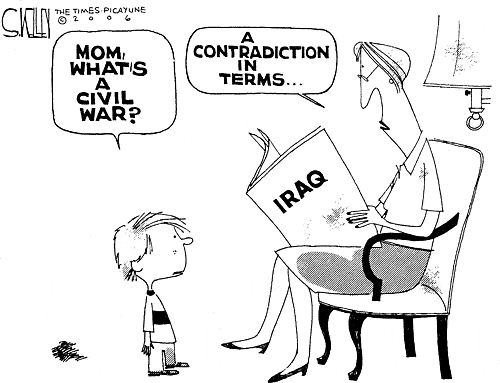
The image “http://img.slate.com/media/1/123125/123036/2133834/2139368/060411_For_CivilWarCartoon.gif” cannot be displayed, because it contains errors.

What follows is a quote from Arthur Silber, and many links that take us on a tour of his mind.

This blog has a kind of perennial identity crisis, partly because I have been using it as a receptacle for things that interest me but don't have a place to go yet.

In the EFM program, we are encouraged to guide thought along theological lines, and to do exercises of reflection. The reflections are on our own individual lives, and also on the culture, the issues before the citizenry, this time in history, on history itself, and on a kind of philosophical thinking.

Silber's blog is called "Power of Narrative" which is a wonderful title in and of itself. Because of instantaneous communication, the narrative of events is more powerful and makes a more long-lasting impression than the event itself --- at least for those at some distance to the event, those who haven't experienced what is being talked about first -- hand.

Like the gospels. Like gossip. Like TV "News".

This aspect of the underlying assumptions, what is the heart of the matter? interests me more and more.

*************

{From "Trapped in the Wrong Paradigm"}

When you argue within the framework and using the terms selected by your opponent, you will always lose in the end. Even if you make a stronger case about one particular issue, your opponent still wins the larger battle -- because you have permitted the underlying assumptions and the general perspective to remain unchallenged.

{From "How the Foreign Policy Consensus Protects Itself"}

Here is a brief excerpt from Gabriel Kolko's The Age of War: The United States Confronts the World, on the same issue -- and note how Kolko's argument parallels that offered by Bacevich:
But collective illusions have characterized the leaders of most nations since time immemorial. They have substituted their desires, ambitions, and interests for accurate estimates of what may occur from their actions. At best, intelligence organizations gather data of tactical rather than strategic utility. An infrastructure of ambitious people exists to reinforce the leaders' preconceptions, in part because they too are socialized to believe what often proves to be illusion. But bearers of bad tidings are, by and large, unwelcome and prevented from reaching the higher ranks of most political orders. It is extremely difficult for nations to behave rationally, which means accepting the limits of their power, and what is called intelligence has to confront the institutional biases and inhibitions of each social system. Thus deductive, symbolic reactions become much more likely, notwithstanding the immense risks of their being wrong. The US war in Iraq and the geopolitical folly of its larger strategy in the Persian Gulf is but one recent example of it.

It is all too rare that states overcome illusions, and the United States is no more an exception than Germany, Italy, England, or France before it. The function of intelligence anywhere is far less to encourage rational behavior--although sometimes that occurs--than to justify a nation's illusions, and it is the false expectations that conventional wisdom encourages that make wars more likely, a pattern that has only increased since the early twentieth century. By and large, US, Soviet, and British strategic intelligence since 1945 has been inaccurate and often misleading, and although it accumulated pieces of information that were useful, the leaders of these nations failed to grasp the inherent dangers of their overall policies. When accurate, such intelligence has been ignored most of the time if there were overriding preconceptions or bureaucratic reasons for doing so.
This is the second common error concerning intelligence, which is the failure to understand its actual uses. As Kolko discusses, intelligence in fact is utilized "to justify a nation's illusions" -- or, in Bacevich's terms, to protect and ensure the continuation of "the prevailing foreign policy consensus with its vast ambitions and penchant for armed intervention abroad."
********

How the Foreign Policy Consensus Protects Itself

Andrew Bacevich, author of the enormously valuable The New American Militarism: How Americans Are Seduced by War, writes about the Iraq Study Group and its purposes:Even as Washington waits with bated breath for the Iraq Study Group (ISG) to release its findings, the rest of us should see this gambit for what it is: an attempt to deflect attention from the larger questions raised by America's failure in Iraq and to shore up the authority of the foreign policy establishment that steered the United States into this quagmire. This ostentatiously bipartisan panel of Wise Men (and one woman) can't really be searching for truth. It is engaged in damage control.

Their purpose is twofold: first, to minimize Iraq's impact on the prevailing foreign policy consensus with its vast ambitions and penchant for armed intervention abroad; and second, to quell any inclination of ordinary citizens to intrude into matters from which they have long been excluded. The ISG is antidemocratic. Its implicit message to Americans is this: We'll handle things - now go back to holiday shopping.

The group's composition gives the game away. Chaired by James Baker, the famed political operative and former secretary of state, and Lee Hamilton, former congressman and fixture on various blue-ribbon commissions, it contains no one who could be even remotely described as entertaining unorthodox opinions or maverick tendencies.

Instead, it consists of Beltway luminaries such as retired Supreme Court Justice Sandra Day O'Connor and lobbyist Vernon Jordan. No member is now an elected official. Neither do its ranks include any Iraq war veterans, family members of soldiers killed in Iraq, or anyone identified with the antiwar movement. None possesses specialized knowledge of Islam or the Middle East.

Charging this crowd with assessing the Iraq war is like convening a committee of Roman Catholic bishops to investigate the church's clergy sex-abuse scandal. Even without explicit instructions, the group's members know which questions not to ask and which remedies not to advance. Sadly, the average Catholic's traditional deference to the church hierarchy finds its counterpart in the average American's deference to "experts" when it comes to foreign policy. The ISG exemplifies the result: a befuddled, but essentially passive-electorate looks for guidance to a small group of unelected insiders reflecting a narrow range of views and operating largely behind closed doors.

...

The ISG will provide cover for the Bush administration to shift course in Iraq. It will pave the way for the Democratic Congress to endorse that shift in a great show of bipartisanship. But it will hold no one responsible.

Above all, it will leave intact the assumptions, arrangements, and institutions that gave rise to Iraq in the first place. In doing so, it will ensure that the formulation of foreign policy remains the preserve of political mahatmas like Baker and Hamilton, with the American people left to pick up the tab.

In this way, the ISG will make possible - even likely - a repetition of some disaster akin to


let me offer these links to some previous essays on this specific topic:

Trapped in the Wrong Paradigm: Three Handy Rules (See Rule 2, in particular.)

The Paradigm that Will Not Die

Undying Myths, and Sullivan's Lies on the Path of Penance

Walking into the Iran Trap: A Decision of Policy -- and the Intelligence Won't Matter

The Irrelevance of Intelligence Again, and Collective Illusions

And Still One More Time: Stop Helping the Warmongers

posted by Arthur Silber

Sunday, November 12, 2006


To every people the land is given on condition. Perceived or not, there is a Covenant, beyond the constitution, beyond sovereign guarantee, beyond the nation's sweetest dreams of itself. The Covenant is broken, the condition is dishonoured, have you not noticed that the world has been taken away? You have no place, you will wander through yourselves from generation to generation without a thread. Therefore you rule over chaos, you hoist your flags with no authority, and the heart that is still alive hates you, and the remnant of Mercy is ashamed to look at you. You decompose behind your flimsy armour, your stench alarms you, your panic strikes at love. The land is not yours, the land has been taken back, your shrines fall through empty air, your tablets are quickly revised, and you bow down in hell beside your hired torturers, and still you count your battalions and crank out your marching songs. Your righteous enemy is listening. He hears your anthems full of blood and vanity, and your children singing to themselves. He has overturned the vehicle of nationhood, he has spilled the precious cargo, and every nation he has taken back. Because you are swollen with your little time. Because you do not wrestle with your angel. Because you dare to live without God. Because your cowardice has led you to believe that the victor does not limp.

Leonard Cohen: Book of Mercy, McClelland and Stewart, 1984, Toronto.

Thursday, November 02, 2006

All Souls' Day 2 November

All Soul's Day is the last day of a triduum (a three-day celebration) of commemorations of the dead dating back to pre-Christian eras. Starting with the Eve of All Hallow's (Halloween) then continuing to All Saints Day.

The pre-Christian Celts of northern Europe held a three day festival known as Samhain, during which they paid particular attention to the memory of their dead. The Church Christianized this festival by giving new meanings to the customs of Halloween night, and by offering a vision of the Communion of Saints that is remembered on All Saints Day, November 1st.

All_souls_day_bouguereau The last day of this Christianized commemoration of the dead is known as All Soul's Day, falling on November 2nd. On this day, the Church remembers all of the faithful departed who died peaceable deaths with the expectation of Christ's promises of eternal life. These were ordinary people, who were not given the status of sainthood by the Church, but who were nevertheless saintly communicants. These days, most Churches call all Christians saints, a concept referred to as the Common of Saints. However, it must be remembered that this is an ancient theology that has only recently been reclaimed.

For much of history, a person known as a "Saint" was only a person who had done some heroic deed for the benefit of the Church and the Faith, or who had died specifically because of their proclamation of that faith (ie, martyrs). These were the persons who were honored with canonization and were remembered on the Church's calendar. They were believed to have ascended directly to heaven at the deaths and welcomed there by God.

The Feast of All Soul's was added to the triduum at a much later date than All Saints Day or All Hallow's Eve. Even after Samhain in the north had ceased to be remembered, the Celts still had a cultural impulse to celebrate for three days, as if they knew they were supposed to be doing so but couldn't remember why. Elsewhere in the Church, monasteries had established the custom holding requiem masses for the brothers of their order who had died. These requiems were held at different dates throughout the year, depending on the region and the monastic Order. The Church thought it reasonable to unify all of these commemorations on a single date for the sake of liturgical order. Therefore, by the turn of the Second Millenium, the Church had established the triduum of commemorations that began on October 31st and ended on November 2nd.

In the Latin world (southern Europe and Latin America), All Soul's Day is known as the Day of the Dead. On this day, families are reunited in the cemeteries where their ancestors are buried. During these family reunions, they decorate their ancestors' tombs and hold parties which begin in the afternoon and continue on into the evening.

These are not morbid celebrations, as one might expect, but very happy and positive celebrations that are intended to bring back happy memories of the ancestors that are very much included in the celebrations.

(adapted from Mission St. Clare)

O God, the Maker and Redeemer of all believers: Grant to the faithful departed the unsearchable benefits of the passion of Your Son; that on the day of His appearing they may be manifested as Your children;

through Jesus Christ our Lord, Who lives and reigns with You and the Holy Spirit, one God, now and for ever. Amen.


Give us Grace so to follow these Your blessed saints in all virtuous and godly living, that we may come to those inexpressible joys that You have prepared for those who truly love You; through Jesus Christ our Lord, Who with You and the Holy Spirit lives and reigns, one God, in glory everlasting. Amen.

Tuesday, October 31, 2006

Jerome_2St. Jerome is best known as a fourth century translator of the Bible from its original languages into Latin, then becoming the language of the Church


JEROME

In Dürer’s engraving
You sit hunched over your desk,
writing, with an extraneous
halo around your head.
You have everything you need: a mind
at ease with itself, and the generous
sunlight on pen, page, ink,
the few chairs, the vellum-bound books,
the skull on the windowsill that keeps you
honest (memento mori).
What you are concerned with
in your subtle craft is not simply
the life of language—to take
those boulder-like nouns of the Hebrew
text, those torrential verbs,
into your ear and remake them
in the hic-haec-hoc of your time—
but an innermost truth. For years
you listened when the Spirit was
the faintest breeze, not even the
breath of a sound. And wondered
how the word of God could be clasped
between the covers of a book.
Now, by the latticed window,
absorbed in your work,
the word becomes flesh, becomes sunlight
and leaf-mold, the smell of fresh bread
from the bakery down the lane,
the rumble of an ox-cart, the unconscious
ritual of a young woman
combing her hair, the bray
of a mule, an infant crying:
the whole vibrant life
of Bethlehem, outside your door.
None of it is an intrusion.
You are sitting in the magic circle
of yourself. In a corner, the small
watchdog is curled up, dreaming,
and beside it, on the threshold, the lion
dozes, with half-closed eyes.

- Stephen Mitchell


Literally, yes, "the word becomes flesh," the sacred language comes alive, bursts from the text into life. "Flesh" is descriptive of more than human being, of mule and leaf-mold and sunlight, of all the earth.

If Jerome was the man evoked by Stephen Mitchell, and heard his words, I can imagine him at such a moment taking up his quill pen and writing his own poem in response, something in the spirit of these lines by Robinson Jeffers:


..... I entered the life of the brown forest,
And the great lfe of the ancient peaks, the patience of stone, I felt the
changes in the veins
In the throat of the mountain... and, I was the stream
Draining the mountain wood; and I the stag drinking; and I was the stars
Boiling with light, wandering alone, each one the lord of his own summit;
and I was the darkness
Outside the stars, I included them, they were a part of me. I was mankind
also, a moving lichen
On the cheek of the round stone...

_______________________

"I was mankind also, a moving lichen on the cheek of the round stone..." That is as lovely an image of homo sapiens as I know--as lovely and as necessary to absorb into our hearts, that we might renew ourselves and restore the earth we continue to destroy.


I am indebted to Leslie J. Hoppe, O.F.M., for his account of Jerome's life in the Church and the character of his translations, and to Joanna Macy's book, Coming Back to Life, for the gift of Robinson Jeffers' poem embodying earth consciousness. It is an excerpt from "The Tower Beyond Tragedy," The Collected Poetry of Robinson Jeffers, ed. Tim Hunt (Stanford University Press, 1988).

Tuesday, October 24, 2006


Photo by www.justinknightphoto.com

Our State of Desperation in Iraq

To the Editor:

I applaud you for a serious treatment of our last best hope to extricate ourselves from the mess that is Iraq (editorial, Oct. 24).

Unfortunately, our executive branch seems incapable of truthful reflection. Any sort of truthful admission of error is still light-years away. At every turn, this administration has resisted with scorn the well-meaning advice of friend and foe alike.

It is a wishful fantasy that this administration would be willing to listen to reason, do the right thing, admit error, fire Defense Secretary Donald H. Rumsfeld, give up its dreams of a utopian future and buckle down and do the hard work of reconciliation.

These officials will not change because there has been no pressure on them to do so from a fawning press that won’t face the truth, a deluded public that thinks “staying the course” and whatever other slogan lobbed at it is a “plan,” and a supine Congress that is busy feathering individual nests and attacking one another.

What will be the wake-up call for this country?

The real world is the world of compromise and peacemaking. I hope that there is a way out of our heartbreaking state of division and loss. I hope that the country I love is still capable of waking up from this nightmare and of restoring reason and sanity.

Elizabeth Scupham
Atlanta, Oct. 24, 2006


You Are a Hunter Soul

You are driven and ambitious - totally self motiviated to succeed
Actively working to acheive what you want, you are skillful in many areas.
You are a natural predator with strong instincts ... and more than a little demanding.
You are creative, energetic, and an extremely powerful force.

An outdoors person, you like animals and relate to them better than people.
You tend to have an explosive personality, but also a good sense of humor.
People sometimes see you as arrogant or a know it all.
You tend to be a bit of a loner, though you hate to be alone.

Souls you are most compatible with: Seeker Soul and Peacemaker Soul


Your Sexy Brazilian Name is:


Luciana Arósio


Tuesday, October 17, 2006

Desert Fathers
The image “http://www29.homepage.villanova.edu/christopher.haas/antony-jpeg.jpg” cannot be displayed, because it contains errors.

Antony

I know that this Sunday will be the feast of St. Teresa of Avila (who I wrote about here last October 15th), but when I hear the Gospel reading this coming weekend at Mass, I will--in part--be thinking about St. Antony of Egypt (a.k.a. St. Anthony of Egypt, or also either spelling with "of the Desert," or "the Abbot"), the "original Desert Father," regarded as the Father of Western Monasticism (as distinct from him regarded as the "founder" of Western Monasticism, which would be St. Benedict of Nursia), and the patron saint from whom I take my confirmation and oblate name, which I now use almost exclusively in public and private. You could sorta say that St. Antony is "my saint."

The reading (linked above) is from St. Mark's Gospel, chapter 10, about a wealthy young man who comes to Jesus and asks what he must do to "inherit eternal life." Jesus' answer to him is, "Go, sell what you have, and give to the poor and you will have treasure in heaven; then come, follow me." And the man goes away sad, because the call is too radical; he cannot part with his wealth to fully follow Jesus as a disciple.

St. Antony (b. 251, d. 356) was a wealthy young man, raised by Christian parents. He heard that same Gospel reading one Sunday, and took it directly as God speaking to his own heart. And he obeyed what he believed to be the voice of God to him in the scripture. Literally. He sold his estate and gave the money to the poor. Then he went alone into the Egyptian desert to seek God.

Such a literal reading and application of the scripture may be embarrassing and unsettling to us today. And certainly, as I have delved deep recently into the Desert Fathers, I find that some of the stuff they did in terms of their asceticism was harsh, downright crazy, way over the top, by our ways of thinking today. Antony wasn't really much of an exception to this extremist tendency in the desert spirituality. It helps to understand the context and motivation of the "abbas" and "ammas" who fled the society and civilization of their day for the desert. They saw the world system in their day as corrupt beyond repair and often saw the Church as complicit in that corruption, as well as corrupted itself, by being so cozily married to the empire. Hmmm, I wonder if there are any parallels their to our own day...? But I digress. The purpose of this post is not a veiled political statement.

These were desperate men and women, the Desert Fathers and Mothers, and they lived their faith and call in desperate fashion. In the case of Antony (and others), he took to himself a single-hearted goal: Christlikeness. He renounced possessions so that nothing physical would have any hold on him, and would require his allegiance in any way. Then, as Richard Foster says about him in the book Streams of Living Water, "...he renounced speech in order to learn compassion; he renounced activity in order to learn prayer."

His biographer, St. Athanasius of Alexandria, tells fantastic tales of his battles with demons in the desert, stories that seem very strange to us now. But these "battles with demons" (literal ones, in the case of the biography), were against temptations. He fought demons of "food," "worry," "lust," and then more blatant sexual temptation, as the demon "assumed the form of a woman and imitated her every gesture" (from the Life of Anthony), and on and on. Antony fought the battles and he won, or rather, as Athanasius puts it, "..this was in Antonius the success of the Savior." Following the battles with demons, there were visions and mystical experiences.

Antony inspired me early on in my readings of the lives of the saints, and I chose him as my main patron and intercessor during my RCIA journey last year. One of the things that so resonated with me about Antony was that his story for me is more than a fantastic tale about battles with real demons. His story is about the conquering of self, of my demons within.... Antony was never afraid of honest self-examination, of brutal self-scrutiny. Neither must we be. We must honestly know ourselves, the good, the bad, and the ugly (very ugly) to progress in this life of radical discipleship in Christ. Self-knowledge is crucial to self-mastery. This is one of the lessons that Antony teaches me.

The purpose of the desert in Antony's day--and the purpose that remains today in each of our own "deserts"--was training in spiritual discipline. Whether it be fasting and/or solitude to achieve needed focus amid the din of life around us or the din within us, or meditation and prayer to deepen our communion with God, or scripture study and lectio divina to transform the mind and form it more in the way of Christ, these and many more are the "deserts" to which we must "flee" today. Athanasius writes about what distinguished Antony from others (bold emphasis mine): "...stability of character and...purity of the soul. His soul being free of confusion, he held his outer senses also undisturbed, so that from the soul's joy his face was cheerful as well."

Woman walking

Slacktivist

Oct 16, 2006

All dogs go to heaven

From comments, toxicfur writes:

When I was a kid and my first pet (a rabbit) died, I made a comment that at least I'd be able to see poor Wiggles in heaven. My dad, a fundie and an asshole, explained that animals don't have souls -- they just cease to exist, and that I'd never see the rabbit again. It seemed perfectly reasonable to him, but I was devastated. My mom -- a much more reasonable person -- explained that we don't really know what happens to animals, but that since heaven is perfect, then we should be able to see our loved ones, even our pets, after we die.


Growing up among the fundies, I met a few folks like toxicfur's dad -- stern men who believed God was a stern man, and who seemed to enjoy gravely informing children that their dead pets were soulless, unloved by God and unwelcome in the Great Hereafter.* Presumptuous idiots, all, speaking with utter certainty based on nothing. Literally nothing -- based on the absence of anything explicit in our Bible regarding God's relationship with other creatures.

OstrichI say "our Bible" because, inspired though it may be, it is a book written by and for humans and as such doesn't address questions that are, as C.S. Lewis put it, none of our business. God's relationship with the beasts is between them and God, so it's presumptuous to speak with certainty on the matter.

We do have some hints, however. Look around. Haldane's quip that God must be "inordinately fond of beetles" seems to me to be good theology. My sola-scriptura friends, of course, are suspicious of any theologizing except that from the page ("look around" is, to them, flirtation with heresy). But there are plenty of hints on the page as well.

The Book of Job, for example, tells us that God is immensely fond of, and proud of, ostriches. Just as small children can't imagine Heaven being heavenly without the presence of their beloved pets, it seems the God of Job couldn't imagine a Heaven in which there weren't ostriches running about, neglecting their eggs and generally behaving like ostriches. And it's worth mentioning that some of the imagery used to describe the blessed kingdom includes the presence of animals. See for example Isaiah 11:5-7. Toxicfur's dad is on shaky ground if he wants to argue that while that passage may mention wolves, lambs, leopards, goats, calves, lions, yearlings and bears, it doesn't specifically mention rabbits, so therefore Wiggles et. al. must be fated for annihilation.

In the same long monologue in which God praises ostriches, God also talks about Orion -- a reminder that the target audience for the Book of Job, as for the rest of the Bible, is humans from Earth (the only place in the universe from which Orion looks like Orion). And just as it would be pointless to look to our earthling's Bible to discern the particulars of the relationship between God and the Rigelians (if there are any), it's also pointless to look to our human's Bible for insight into the eternal disposition of other earthly creatures for whom our Bible was not written.

We are told that in our father's house there are many mansions. We are not told, and so we cannot say, whether there are also many gardens, pastures, forests, swamps, deserts and streams. I suspect, and also hope, that there are. It seems to me both parochial and chauvinist to decide that, since God has promised us heaven, God can't have promised any such thing to anyone else -- beast or bird, trilobite or pteradactyl, beetle or Betelgeusian.

The odd thing about people like toxicfur's dad is the vehemence with which they insist on excluding the animals from their vision of heaven. Here I think theologians can learn from those FBI profilers who hunt serial killers. The serial killers always start by doing things to animals, but they never stop there. They always end up doing the same things to humans.

- - - - - - - - - - - -

* I appreciate that many reasonable people of good will don't believe there is any such hereafter, or any such thing as heaven. It's easy if you try. For my part, there are many heavens, or ideas of heaven, in which I don't believe either. Included among them is the idea that heaven is completely other-worldly, that it is wholly unrelated to the here and now.


*******************
Our odd ideas and arguments about God and the Bible will always be around. What's needed are more adult human being who have ingested what is whole and sound with the Bible, have made it their own.

Who have set out now to live that life that demonstrates God's love, and pours that out. As for the rest, maybe it's truly "none of our business."

Thursday, October 12, 2006


(from Rigorous Intuition)


Fight the Real Enemy


Gonna raise me an army, some tough sons of bitches
I'll recruit my army from the orphanages - Bob Dylan


In the United States, in the forshortened weeks before its next post-modern election, every action appears to have an equal and opposite distraction. Telling one from the other, that's the hardest thing.

This time, the Democrats may do just well enough to revive faith that the system works and that its workings are of consequence. (Like Jonathan Richman sings in "Walter Johnson": "Boys, this game's no fun if you don't get a hit once in a while.") Simone Weil wrote that "imagination and fiction make up more than three quarters of our real life," and if we can't imagine a better world than this then we can be certain one will be imagineered for us. A bipartisan soft tyranny that rules by mass delusion will concede the odd happy ending, that is actually neither.

The quote is from Weil's essay "Some Thoughts on the Love of God." They're wartime words, written during the worst of it, and imagination and storytelling remain our best means to interpret our attenuated circumstance that already passes understanding.

And everywhere is war. Fourteen years ago, Sinead O'Connor's storytelling on Saturday Night Live sounded to many like hateful babbling, but I expect today it would sound to more like fearless love. The Pope's picture was remembered, but not the child's. Maybe now, because we know more, it would be.

Mark Foley, we know, had been the co-chair of the House Caucus on Missing and Exploited Children, which was formed to provide federal assistance to the National Center of the same name. Its Board of Directors includes Floridian cocaine smuggler Hank Asher who founded the corporation which purged his state's voter rolls in 2000. In 2003 he was hired to help identify potential terrorists for Florida's Department of Law Enforcement. ("This has been highly controversial, largely because of Asher's alleged past links to drug smuggling.") Foley himself played a leading role in suppressing the hand recount. So what are such men with such histories, and in such a state as Florida, doing orbiting about the issue of missing and exploited children?

(And it may be more curious still. A poster on the RI forum links Foley with Bush family favourite Mel Sembler's juvenille mind control enterprise "Straight," and connects Straight to Paul Bishop of the Johnny Gosch snake pit.)

"Don't get distracted - stay focused" - a lot of Don't Stop Thinkin' About Tomorrow Democrats will be saying that more than usual this month. Many of them think Foley represents a distraction, albeit a happy one. But perhaps it's the election itself that distracts Americans with a shiny hoax battlefield, away from the real war they would know better if they would heed the dis-ease of their storytellers.
posted by Jeff

{in comments}


I think that to read Jeff's blog, you have to be able to maintain what my husband calls a "grey area" -- things that you neither know to be true nor know to be untrue, but are willing to entertain as possibilities pending further information.

Many of the areas Jeff covers don't even have an "official theory" that he's competing with -- nobody else is talking about them at all, or trying to draw the pieces together. Jeff is pointing to something real and meaningful, even if he doesn't have all the details right, and that in itself is far more important than asking "where a reader or thinker should draw the line of belief."

Similarly, I think the dichotomy between "incompetent profiteers" and all-knowing masterminds is a false and misleading one. We live in the realm of intermediacy, and like everything else, Cheney and company are somewhere in the middle -- doing their best to manipulate events but as often as not running up against the Law of Unintended Consequences.


{from Rigorous Intuition}

"A few months ago I read a book by Charles Upton that was pubished by Sophia Perennis press. The author Upton and this book have been mentioned by a number of posters on this site before as being relevant to most of the topics of discussion that are a focus of Rig Int. The first time through it, I was a bit skeptical. After reading the book through carefully once, I wasn’t sure whether to put much stock in either the author nor the book. But a second close reading has convinced me of the author’s sincerity and relative degree of insight.

After reading the book's 520 pages through a second time, and in light of current ongoing political events, I have come to the conclusion that, all in all, it is rather brilliant. Below is a brief excerpt that I ahve typed out by hand, because I think it hits the nail squarely on the head with regard to the current geopolitical machinations vis a vis the “clash of civilizations”. Keeping in mind this broader view could help innoculate the unwary against becoming infected by any potential upcoming "October Surprise", such as that which might occur this Friday, October the 13th, the 699th anniversary of French King Phillipe the Fair's arrest of the Knights Templar and seizure of much of their vast wealth.

While one may not have the time nor the inclination to read a 500+ page book, one might well find the following two page political meta-analysis to be of interest. I think that it is especially insightful, considering that it was written in the late 1990’s and year 2000, and published 1 February 2001. Upton seems to have anticipated such things as the “War on Terrorism”, a.k.a. the “Long War”, and the concerted efforts of the Western media to marginalize and demonise Islam, in service of protracted social and military conflict, all with a particular endgame or eschatology in mind. Note while reading this that Upton is not a Christian, but rather a Muslim, in particular a Naqshbandi Sufi.

“In a world profoundly polarized between the Gog of syncretist globalism and the Magog of exclusivist ‘tribalism’ – a word which is beginning to denote what used to be called ‘nationalism’ or ‘patriotism’ or ‘loyalty to one’s religion’ – the Transcendent Unity of Religions clearly represents a middle path, or third force, at least in the religious field. It is equally opposed to the universalism of the global elites and the violent self-assertion of the fundamentalist ‘tribes’ oppressed and marginalized by these elites. Perhaps this is one reason why groups and individuals who hold to this doctrine have been subjected to the immense degree of psychic pressure which observers on the outskirts of the Traditionalist School, such as myself, cannot fail to note. It is reasonable to conjecture that Antichrist would like nothing better than to subvert and discredit the Traditionalists, since the Transcendent Unity of religions is one of the few worldviews that could possibly stand in the way of the barren and terminal conflict between globalism and tribalism which is the keynote of his ‘system’ in the social arena.

If all possible alternatives to the struggle between globalism and tribalism disappear from the collective mind, the Antichrist has won. He can use economic and political globalism and the universalism of a ‘world fusion spirituality’ to subvert and oppress all integral religions and religious cultures, forcing them to narrow their focus and violate the fullness of their own traditions in reaction against it. He can drive them to bigoted and terroristic excesses which will make them seem barbaric and outdated in the eyes of those wavering between a global and a tribal identification, and set them at each other’s throats at the same time. Unite to oppress; divide and conquer.

In this light, we can see that the exclusivism of conservative and/or traditional Christianity is both its greatest strength and its greatest weakness; the same could be said, with certain reservations, of Judaism and Islam. The exclusivism of these Abrahamic religions allows them to consciously fortify themselves against the System of Antichrist – Christianity by its ‘catacomb spirit’, its ability, ultimately derived from monasticism, to build spiritual fortresses against the world, and Islam by the fact that dar al Islam remains the largest bloc of humanity which, in part, is still socially and politically organized around a Divine Revelation, although to greatly varying degrees, as were Medieval Europe and the Byzantine Empire.

On the other hand, their very exclusivism has prevented these religions, in all but a few instances, from making common cause against globalist universalism and secularism. They remain vulnerable to the ‘divide and conquer’ tactics of the system of Antichrist, a phase which could well be the prelude, if traditional eschatological speculations such as those found in Dennis E. Engleman’s Ultimate Things are to be believed, to a later ‘unite to oppress’ phase – a capitulation by the exhausted exclusivists, longing for the end of endless conflict, to the satanic universalism of Antichrist himself.

According to Ultimate Things, Antichrist will reveal himself in Jerusalem and proclaim himself King of the Jews; the Jewish nation, as well as many Christians, will accept him. From the Islamic perspective, however, any world ruler who begins as a King of the Jews and is later submitted to by the Christians would be immediately and universally recognized as Antichrist himself. It is inconceivable, unless traditional and even fundamentalist Islam were to virtually disappear, that such a figure could tempt Muslims to accept him as the Mahdi or the eschatological Jesus. So if the predictions Engleman recounts are in any way accurate, he is in fact presenting, as the most likely eschatological scenario, a mass apostasy of Jews and Christians which would leave only the Muslims aware of who Antichrist really is, and ready to do battle with him. How then could Antichrist emerge as a true global monarch, albeit a satanic one? Perhaps the militant opposition of an Islam discredited in the eyes of the rest of the world to an almost universally admired ‘savior’ is the very thing which will ultimately consolidate his power. I hasten to say that this is in no way a prediction; God forbid. I am simply allowing myself to imagine various scenarios based on the quality of ultimate irony and self-contradiction which is the keynote of all historical forces in these latter days. And one of the twists of this irony is fact that many semi-secularized Muslims seem much more in tune with the mores of postmodern globalist culture than any Christian I could name.

If the greatest strength and greatest weakness of traditional Christianity is in its exlusivism, the comparable strength and weakness of Buddhism, especially in the West, is in its ability to ‘fit in’. (The same goes for heterodox Westernized Hinduism and various influences, such as Feng Shui, Taoist meditation, and Sino-Japanese martial arts, originating in the Far East.) At its best, this represents a radical detachment from the norms of ‘the world’, allowing it to avoid all forms of dogmatic literalism and fundamentalism and the marginalization such a stance often entails. At it worst, it indicates a capitulation to the collective egotism of this very ‘world’.

In the United States at least, Buddhism is an acceptable part of the general Neo-Pagan cultural drift, which, while it may not identify with globalism, nonetheless often ends by serving it. (The same is true of certain strands of American Sufism, especially those which attempt to separate the Sufi tradition from Islam.) As a religion which recognizes a fall (into ignorance) and posits a goal of salvation (via enlightenment), it ‘naturally’ has a much greater affinity with the Abrahamic religions than with a Paganism which accepts the ontological status quo and seeks only to profit from it. But that’s not how things have worked out sociologically. American Buddhism, as a non-theistic religion (though certainly not an atheism, since it possesses a doctrine of the Absolute), has been attractive to many people – especially, as it turns out, many American Jews – who are in flight from their own narrow-minded and superstitious ideas of God. An acquaintance of mine, a traditional Catholic who studied for years under the Hopi elders, tells the story of a ‘Buddhist Halloween party’ where a well-known American Buddhist teacher, dressed as a ‘Sufi’, made the statement that Buddhism is better than the Abrahamic religions because, just like the Native Americans, the Buddhists don’t believe in God – a statement which my friend knew, from long personal experience with Native American spirituality, to be totally false. It was nonetheless an idea which would ‘play well’ to the general liberal, New Age and Neo-Pagan culture from which this teacher draws his students, the kind of people whose appreciation for the American Indians is even more destructive to Native American spirituality than their attraction to Buddhism is to Buddhism.

The false ecumenism of Neo-Pagan, New Age culture is the seed-bed for that ‘world fusion spirituality’ in which fragments of every spiritual tradition are promiscuously thrown together, to their mutual corruption. True ecumenism on the other hand – the outer expression of the ‘esoteric ecumenism’ of the Transcendent Unity of Religions, which understands the very uniqueness and particularity of the authentic religious traditions as the transcendent basis for their unity – is not a syncretistic amalgam or a diplomatic glossing-over of doctrinal differences, but a united front against a common enemy: that unholy alliance of scientism, magical materialism, idolatry of the psyche and postmodern nihilism which is headed, with all deliberate speed, toward the system of Antichrist.”
Charles Upton, The System of Antichrist, pp. 490-492
The System of Antichrist: Truth And Falsehood in Postmodernism And the New Age

and

from a review via amazon of this book;

Make no doubt about it - Charles Upton has written an absolutely excellent book, destined to become a classic. Despite its length (500+ pages) it is written in a brisk, almost breezy style, and lends itself well to non-linear reading if you are so inclined. Indeed, you will probably wish to skip at least one or two small sections of the book, as the purpose of this book is several-fold.

First of all, it introduces the reader to the "Traditionalist" school of theology and philosophy exemplified by Coomaraswamy, Guenon, Schuon, Lings, et al. While it's difficult to do justice to the Traditionalists in one paragraph (and they are a disparate bunch in their own right) they can probably be said to espouse a "perennial philosophy" that strives for a universal spiritual understanding that at the same time sets absolute standards.

This is a sharp contrast from various postmodern and New Age doctrines, which essentially hold that "all paths lead to the same source" and that there is no objective truth. Upton traces the geneaology of postmodernism and the New Age movement, showing how successive strains of philosophic and scientific thought have gradually eroded at the notion of objective truth. In Dostoyevsky's words, "Without God, everything is permitted."

The book then refutes popular strands of New Age thought: the ideas and respective cults that have grown around Jane Roberts' _Seth_ material, Carlos Castaneda's _Tales of Power_, James Redfield's _The Celestine Prophecy_, _A Course in Miracles_, Theosophy, Jung, Terence Mckenna and Deepak Chopra's _Seven Spiritual Laws of Success_ all come under scrutiny. At this point, you can probably pick and choose whatever ideology you were exposed to. As a Gen-Xer, the Castaneda and _Seth_ material didn't have much impact on me, but _The Celestine Prophecy_ was certainly widely read during my undergraduate years at college. Upton is not down on everything that these authors have to say; indeed, much of it is positive. What's important to realize here is that, in his own words, New Age doctrines "don't take you all the way."


The problem with much New Age thought, Upton says, is that it might allow for some initial feeling of enlightenment, but it simply doesn't have the time-tested validity of a traditional path. Unfortunately, a lot of the 'follow your bliss' style of New Age thought is not geared towards the pragmatic realm that a spiritual path must take in to account; this often leads to the feeling of being let down after the initial rush of perceived enlightenment is had.

A later chapter on UFO's is particularly interesting. Upton effectively articulates Rene Guenon's notion of UFO's being representative "fissures in the great wall" that appear during the final phases of a complete coalescing of the spiritual into the material world (this is the Kali Yuga of Hindu cosmology, which is a centerpiece of most Traditional thought.) He also (correctly, I believe) points out that these phenomena are manifestations from the psychic or demonic plane, not space brothers heralding a new era of peace and harmony.

The book does occasionally bog down into polemics. Most readers will probably want to skip the chapter that Upton devotes to refuting William Quinn's "The Only Tradition" (which was an attempt to show that Theosophy is compatible with the Traditionalist School.) However, these small asides into academic nitpicking certainly don't detract from the overall strength of the book; it's an excellent introduction to religion, cosmology, and the End Times all in one, and there's hardly a page lacking in quote-worthy passages.

***********
and this;

The more chaos there is in the world, the more many people will wish for a figure who will hold out a carrot and offer to solve the humanity's problems if he is given unquestioning obedience. "Traditionalism" remains an interesting school of thought among a handful of scholars, but it is nothing more than "a school." It cannot attract a mass of believers of all levels of intelligence and education like the Church can. In all, a great book on the nature of reality. The second law of thermodynamics states that as the universe continues, so does entropy. You will NEVER get as much out of something as you put in. Loss, decay, death, dissolution, disorder, darkness. "Matter is entropy," writes Upton, as even our earth is nourished by a Sun, slowly burning itself out. The only hope in this age is indeed a return for whoever can to repent, return to the ancient Way, realize that the world only ends in death, the ultimate defeat, and look forward to where one's state will be in Eternity, unto Ages of Ages.

********
ADDENDUM:

More insight from Upton:

"Our elite rulers did not lead us into tyranny and environmental collapse because they are evil people, but because they were forced to by the nature of capitalism. Capitalism must continually grow in order to survive. If investors have nowhere to increase their funds then they stop investing and the whole system collapses like a house of cards.

"Propaganda myth tells us that capitalism and free enterprise are one and the same thing. They are not. Under free enterprise a business can provide a service or product, make a profit in the process, and continue on stably for many years. Under capitalism such a business would be considered a failure - it does not provide a growth opportunity for an investor. Under capitalism society is forced to continually destroy old ways of doing things and adopt new ways - not because it is good for society but because that is how wealthy investors can increase their wealth still further."


I would add the comment that "capitalism" is a form of - Mammon.

CORRECTION

The quote about capitalism that I said was from Upton was actually from
"Globalization and the Revolutionary Imperative: from Global Tyranny to Democratic Renaissance" by Richard K. Moore, which was mentioned by someone else in this thread. The URL was also mentioned:

http://www.lookingglassnews.org/viewcommentary.php?storyid=55


Plaxo Badge